I measure my work by what my designers can do without me.

Client

Nestlé Nespresso

Project Type

Navigation & information architecture

Role

Global Product Design Lead

Team

Product, Design, Engineering, UXR, Markets

Timeline

2024 - 2025

Rebuilding navigation around how customers think — 3.5× first-attempt task success, across 40+ markets.

Overview

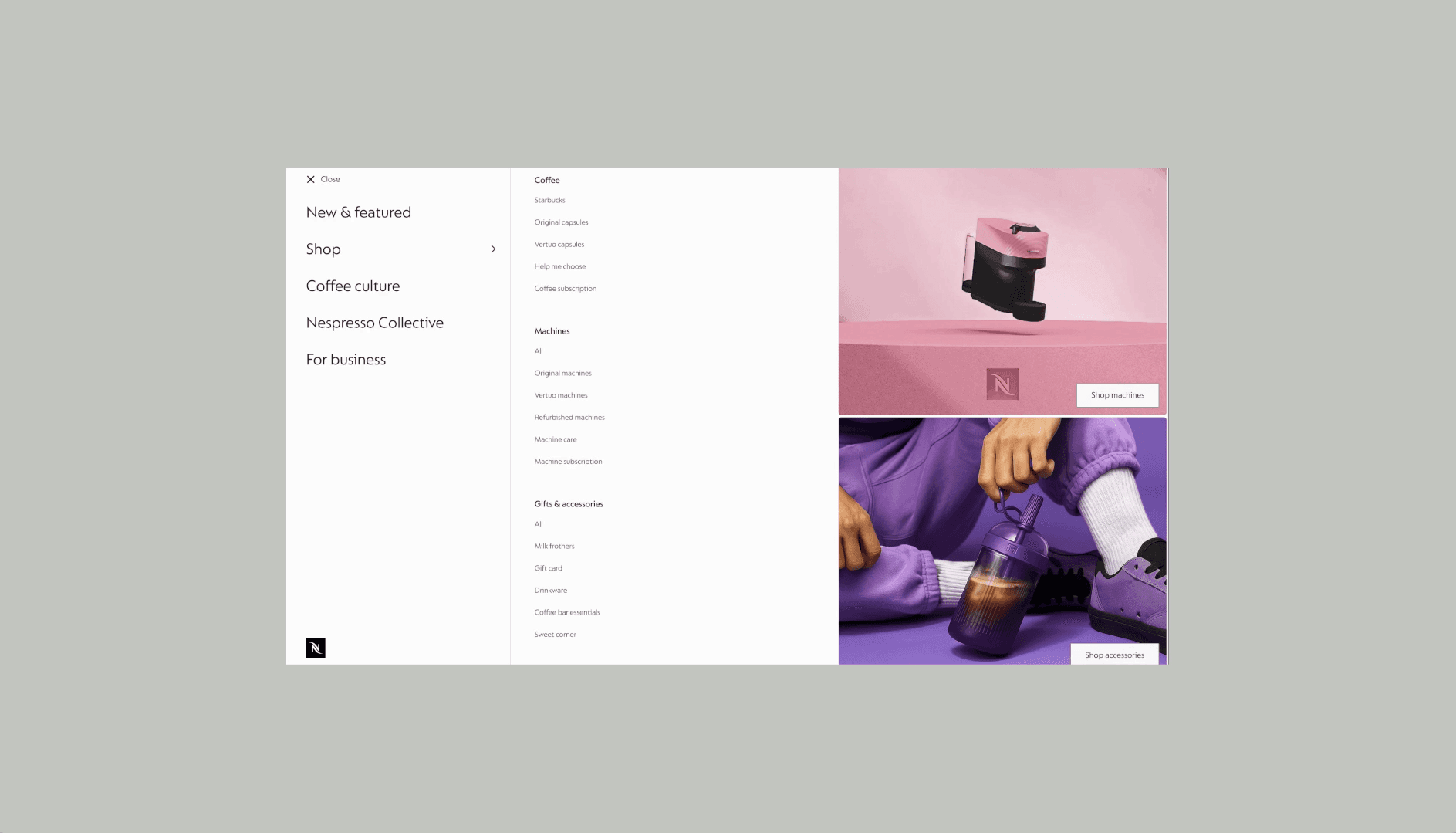
Nespresso’s navigation had grown category by category until it reflected internal structure more than customer expectation — eleven flat items on mobile, no hierarchy, shopping sitting beside order tracking. Meanwhile the business was widening: new coffee formats, partner brands, and a push to make the site somewhere people spend time rather than restock.

A menu tidy-up became a bigger question: how might we build a navigation model customers understand, while supporting different products and commercial needs across 40+ markets?

Scope

Mobile and desktop mega-nav, taxonomy, naming, and the governance model markets work within.

My role

Led navigation and IA strategy end to end, hands-on across research design, card sorting, tree testing, prototyping and validation — with Product, UXR, Content, Engineering and market teams.

Impact at a glance

0%

entered the correct section

0%

first-attempt success, vs 20%

0+

markets aligned

0

Web blocks

0

11 to 5 top-level menu items

Case Study

Design Leadership

Timeline

2017 - 2026

Companies

Nespresso and Kingfisher

Current Role

Global Product Design Lead at Nespresso

Cross-functional collaboration

Product · Design · Engineering · UXR · Service Design · A11y · Design Systems · SEO · Business

Overview

Most designers don't stall because of craft. They stall because nobody's shown them what the next level looks like, or what's quietly holding them back. This case study is about how I develop designers. It covers the frameworks I built at Kingfisher and Nespresso to make growth visible, and two senior designers I coached in opposite ways.

Scope

Career framework · Personal development plan · Insource transition plan · Coaching senior designers

My role

Line manager and coach. I designed the frameworks, trialled them with the team, then rolled them out and coached through them one-to-one. I stay hands-on in critique and on the problems nobody has cracked yet.

Case Study

Design Leadership

Timeline

2017 - 2026

Companies

Nespresso and Kingfisher

Current Role

Global Product Design Lead at Nespresso

Cross-functional collaboration

Product · Design · Engineering · UXR · Service Design · A11y · Design Systems · SEO · Business

Overview

Most designers don't stall because of craft. They stall because nobody's shown them what the next level looks like, or what's quietly holding them back. This case study is about how I develop designers. It covers the frameworks I built at Kingfisher and Nespresso to make growth visible, and two senior designers I coached in opposite ways.

Scope

Career framework · Personal development plan · Insource transition plan · Coaching senior designers

My role

Line manager and coach. I designed the frameworks, trialled them with the team, then rolled them out and coached through them one-to-one. I stay hands-on in critique and on the problems nobody has cracked yet.

At a glance

0+

years across product design and team leadership

years across product design and team leadership

~0

designers led at Nespresso, across B2C and B2B

designers led at Nespresso, across B2C and B2B

0+

markets on Nespresso's global eCommerce platform

markets on Nespresso's global eCommerce platform

0

companies where I built career frameworks

Years cover my full career. Team and market figures cover Kingfisher (2017–2023) and Nespresso (2023–present).

Five things this page proves

1

I develop designers.
I don't just manage them

A career framework, two real coaching stories, and what changed

2

I'm still credible in the craft

Close enough to the work to say what isn't good enough, and why

3

I've closed the premium-brand gap before

A premium product whose digital experience had to catch up

4

Design works inside Product & Engineering

Not a separate kingdom. Constraints shape the answer

5

I care about commercial outcomes

UX quality is how we get there, not where we stop

Developing designers

Growth needs a shared language before it needs a manager.

Nestlé's Success Factors records goals.

It didn't help leads and designers have honest conversations about craft or what “next level” looks like. So I built a Nespresso career framework, adapting one I'd created at Kingfisher around Nespresso's hallmarks, then trialled it with the team before rollout.

Capability levels

01 – WHAT "GOOD" LOOKS LIKE

Six levels, from Learning to Leading, each mapped to a role.

Career path

02 – WHERE YOU'RE HEADING

Two tracks, individual contributor or manager, with a real crossing point.

Core & enabling skills

03 – WHAT TO WORK ON

Three soft, three hard skills, each described at every level.

Personal development plan

04 – PERMANENT TEAM

A yearly reflect, evidence, aspire, commit loop with your lead.

Insource transition plan

05 – KINGFISHER THEN NESPRESSO

A scored evaluation path for contractors moving in-house.

Levels and tracks

6 levels

The IC and manager tracks share one ladder. A Senior can become a Principal without being pushed into people management, and the Product Design Lead role is where management experience lets someone cross over.

Leading

Manager / Specialist

Expert

Principal

Mastering

Senior

Demonstrating

Mid

Growing

Junior

Learning

Intern

ICs

MANAGERS

Craft focused

People focused

Solving problems

Enabling others to solve problems

Tangible outputs

Intangible outputs

Mentoring craft

Intangible outputs

Protected by manager

Protecting the team

Who it's for

The personal development plan

A FigJam template each designer fills in with their lead through the year, then exports into SuccessFactors. It turns the review from a form into a conversation.

1

Reflect on the past 12 months

What went well and what could improve, at 3, 6, 9 and 12 months, plus 360 feedback from colleagues.

3

Career aspirations

More of the same, or a different growth area? Captured before goals are set.

2

Evidence your achievements

Plot real work against the skills matrix, then agree with your lead which level it shows.

Plot real work against the skills matrix, then agree with your lead which level it shows.

4

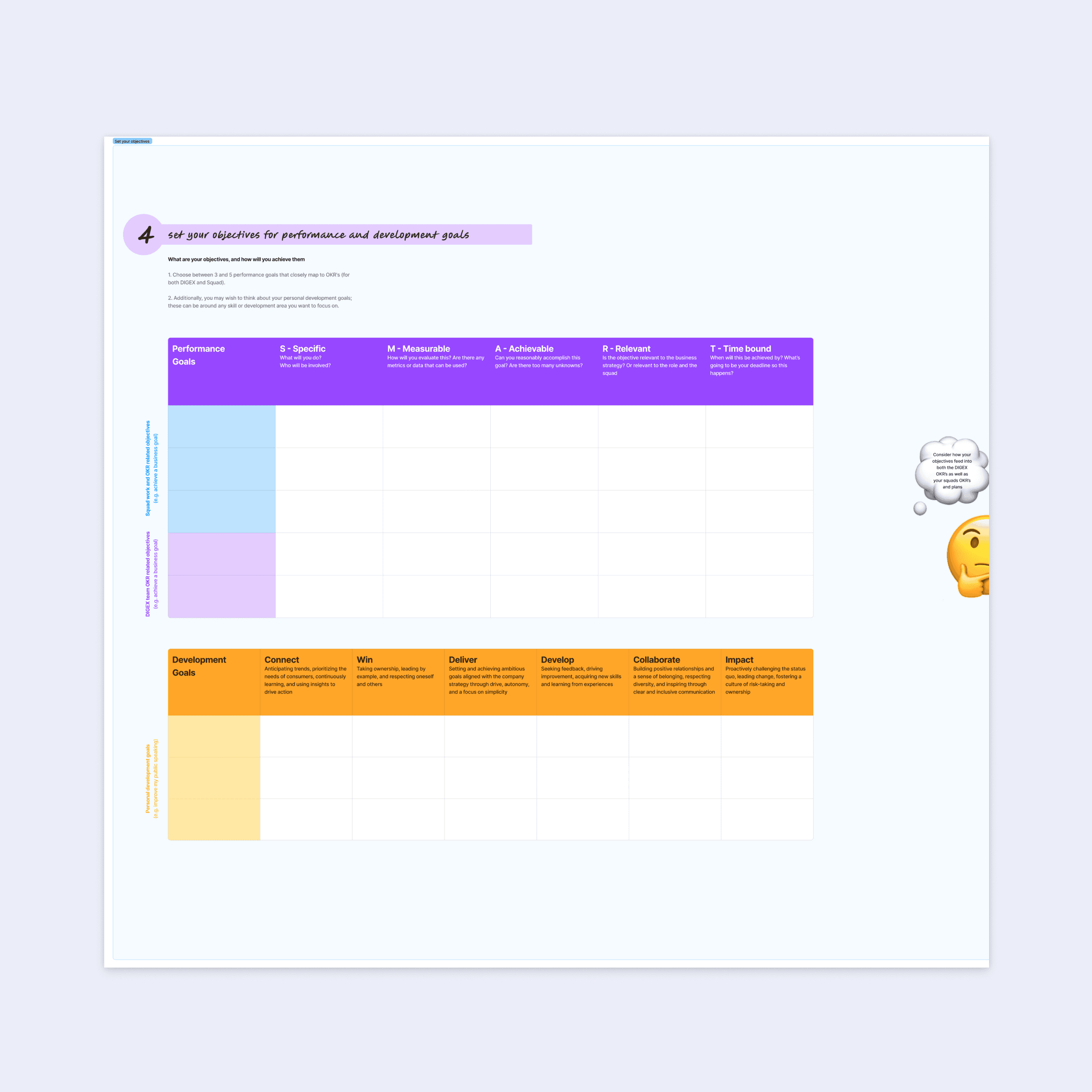
Set your objectives

3 to 5 SMART performance goals tied to team and squad OKRs, plus personal development goals.

  • Step 1 · Reflect, with 360 feedback

  • Step 2 · Evidence plotted on the skills matrix

  • Step 3 · Career aspirations

  • Step 4 · SMART performance and development goals

  • Step 5 · Capturing insights

From the trial

Both sides of the conversation

Several designers and managers trialled the template before it went wider. They valued the structure and clarity it gave to career conversations, which is what gave us the green light to roll it out across the team.

Manager, from the trial

Helps me understand my team's aspirations through honest conversations and supports during challenging moments.

Direct report, from the trial

It's a vital tool for fostering a transparent, supportive environment where everyone can truly thrive.

For contractors

The insource transition plan

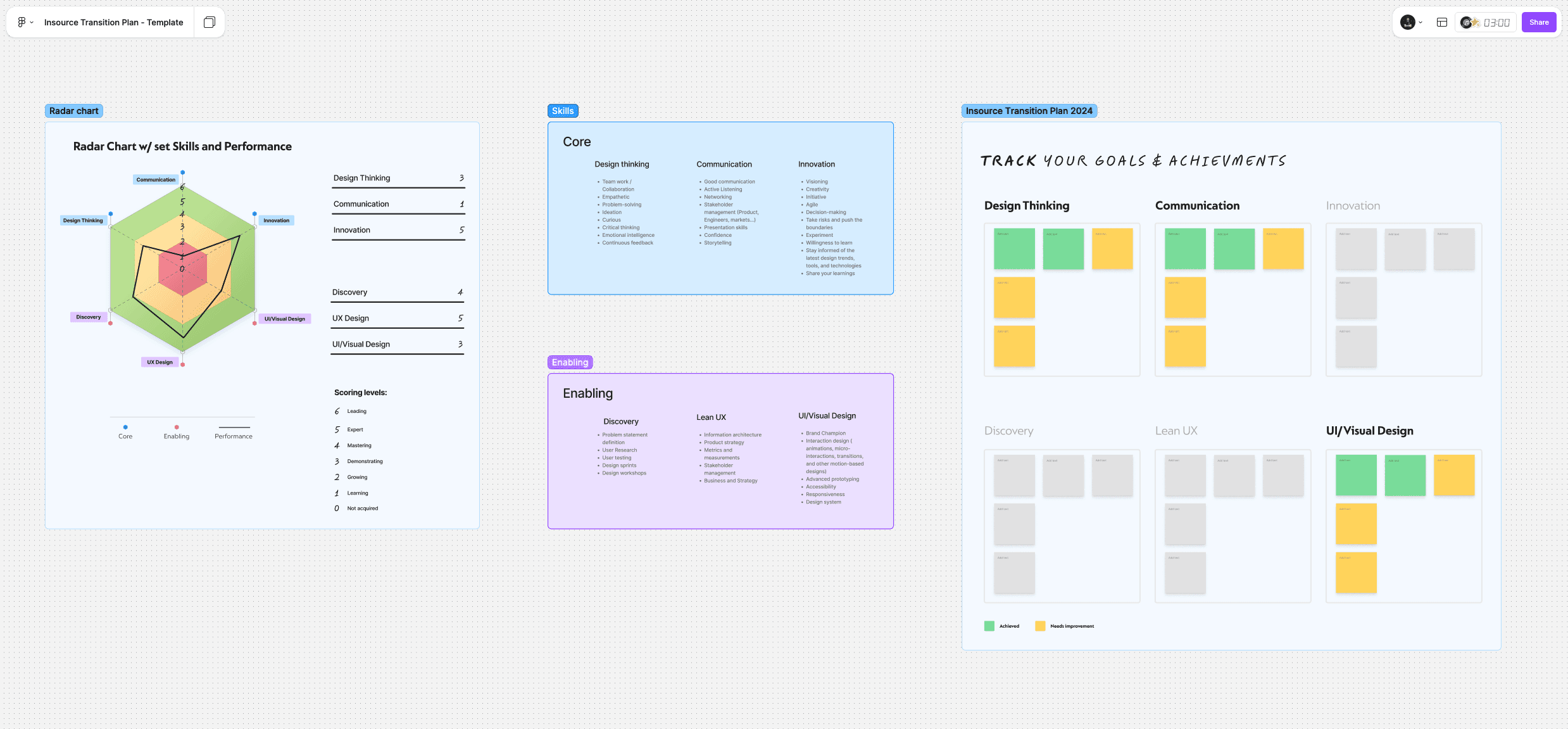
When contractors move in-house, the risk is that nobody agrees what they're being assessed on. I first built this at Kingfisher and rebuilt it for Nespresso: a scored, time-boxed plan that gives the designer a fair path and gives the business a clear read on progress.

1

Understand your areas

Core and enabling skills, three detailed categories in each.

3

Set objectives

Pick the areas of focus the scores point to.

2

Score yourself

A 0 to 6 radar chart, filled in honestly with your lead or mentor.

A 0 to 6 radar chart, filled in honestly with your lead or mentor.

4

Track it

Regular check-ins, each goal marked achieved or needs improvement.

"Being a manager is a mindset shift. You're no longer a player, you're the coach. You can't score the winning goal anymore, no matter how hard you try."

Leo Widrich · Co-founder, Buffer

Developing designers · in practice

Two senior designers who needed opposite things.

When contractors move in-house, the risk is that nobody agrees what they're being assessed on. I first built this at Kingfisher and rebuilt it for Nespresso: a scored, time-boxed plan that gives the designer a fair path and gives the business a clear read on progress.

Story A · Senior Product Designer

Great work that nobody heard about.

When I started

She'd just stepped up to Senior. Her work was really strong and she had great ideas, but she was quite introverted and didn't always get heard, especially in bigger meetings.

The real gap

Not craft. Confidence and influence. Developing a senior designer isn't always about making them a better designer.

What I did

I stopped presenting on her behalf and made space for her to own the conversation. We'd prep beforehand on what she wanted to land. Afterwards I'd give feedback on what worked and where to push further. Then I deliberately stepped back more, meeting by meeting.

What changed

She got comfortable presenting her own thinking, challenging people and representing her work. Success wasn't her needing me. It was the opposite.

Observable outcome

Six months later she was confidently leading stakeholder sessions without me.

Observable outcome

Six months later she was confidently leading stakeholder sessions without me.

Story B · Senior Product Designer

Brilliant, fast, and doing it all himself.

When I started

Very experienced and very quick. Faced with a problem, his instinct was "I'll just do it", and he'd usually have it solved before everyone else had finished discussing it.

The real gap

He performed brilliantly on his own, but the people around him weren't benefiting from his experience. Sometimes other designers felt they weren't adding much.

What I did

Told him straight: at his level, impact isn't only what you personally produce. Part of being senior is making the people around you better. I pushed him to slow down now and then, bring others into his thinking, explain how he got to an answer, critique their work, and leave them room to solve things.

What changed

The goal was never to make him less effective. It was to turn one person's capability into something the whole team could use.

Observable outcome

He started mentoring another designer and became the person the team actively went to for feedback.

Observable outcome

He started mentoring another designer and became the person the team actively went to for feedback.

Story A

She needed more voice

Development area: confidence and influence

My move: create the stage, prep, debrief

Who stepped back: me

Story B

He needed to make room

Development area: multiplying his impact

My move: reframe what "senior" means

Who stepped back: him

How I coach

I don't have one coaching method. I work out what's stopping that particular designer from having more impact, and coach around that.

How I coach

I don't have one coaching method. I work out what's stopping that particular designer from having more impact, and coach around that.

Staying close to the craft

I can get into the work and say what isn't good enough.

You can't coach senior designers on judgement you don't exercise yourself.

I still prototype, test and present work end to end when it unblocks a decision, and I run critiques on the team's work every week of the year. Three recent examples.

Navigation & IA across 40+ markets

Nespresso · 2023 to 2025
  • Analytics review and card sorting

  • Three rounds of tree testing

  • Workshops with nine senior leads

  • Unmoderated test: 20 people, 7 countries

Shipped a consolidated five-section navigation, piloted in CA and CH.

PDP rebuilt from scratch

Nespresso · 2023 to 2025
  • Removed header and tab bar to give back 22% of the screen

  • Mapped 17 CMS components

  • Six-state PDP flow, Baymard audit, six research sources

Shipped into the TradePoint and B&Q native apps.

Machine compatibility, hands-on

Nespresso · Revamp
  • I designed, prototyped, tested and iterated the approach myself

  • Then presented it to markets and brought them in with their own data

Validated in follow-up user testing. More on this in section 4.

Critique over redraw

I'd rather ask the question that gets a senior designer to a better answer than redraw their screen.

Hands-on where it counts

A prototype that settles a debate, a flow nobody has cracked. Not a squad's backlog.

Mostly through the team

Roughly 80% leadership, 20% hands-on. Most of the leverage comes through others.

Staying close to the craft

I can get into the work and say what isn't good enough.

You can't coach senior designers on judgement you don't exercise yourself.

I still prototype, test and present work end to end when it unblocks a decision, and I run critiques on the team's work every week of the year. Three recent examples.

Navigation & IA across 40+ markets

Nespresso · 2023 to 2025
  • Analytics review and card sorting

  • Three rounds of tree testing

  • Workshops with nine senior leads

  • Unmoderated test: 20 people, 7 countries

Shipped a consolidated five-section navigation (CA and CH)

PDP rebuilt from scratch

Nespresso · 2023 to 2025
  • Removed header and tab bar to give back 22% of the screen

  • Mapped 17 CMS components

  • Six-state PDP flow, Baymard audit, six research sources

Shipped into the TradePoint and B&Q native apps.

Machine compatibility, hands-on

Nespresso · Revamp
  • I designed, prototyped, tested and iterated the approach myself

  • Then presented it to markets and brought them in with their own data

Validated in follow-up user testing. More in section 4.

Critique over redraw

I'd rather ask the question that gets a senior designer to a better answer than redraw their screen.

Hands-on where it counts

A prototype that settles a debate, a flow nobody has cracked. Not a squad's backlog.

Mostly through the team

Roughly 80% leadership, 20% hands-on. Most of the leverage comes through others.

The premium-brand gap

A premium product deserves a digital experience that feels the same.

Nespresso's coffee and boutiques feel premium. Online, it still behaved like a catalogue. Part of my remit has been repositioning Nespresso as a premium brand online, in support of its channel strategy to 2027. It's a gap a lot of premium, direct-to-consumer brands share.

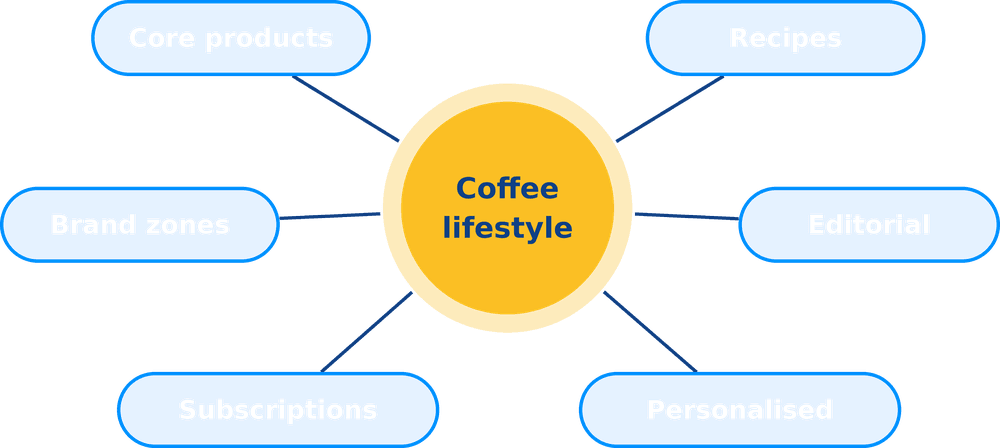
BEFORE · PRODUCT-CENTRIC FUNNEL

AFTER · LIFESTYLE ECOSYSTEM, MANY WAYS IN

BEFORE · PRODUCT-CENTRIC FUNNEL

AFTER · LIFESTYLE ECOSYSTEM, MANY WAYS IN

Inside Product & Engineering

The best idea didn't ship. The right one did.

The Revamp brief looked like a reskin. Discovery showed something bigger: customers buying coffee for the wrong machine system (Vertuo vs Original). Drop-offs, wrong orders, complaints, and market jargon making it worse. The business had lived with it for years.

BEFORE · PRODUCT-CENTRIC FUNNEL

AFTER · LIFESTYLE ECOSYSTEM, MANY WAYS IN

What I learned

Closing the gap takes more than a reskin.

Design for the portfolio you'll have

Nespresso had Original and Vertuo, with Starbucks and Blue Bottle arriving. We built the experience to flex across brands from day one, instead of redesigning each time a new one landed.

Consistency without sameness

A modular navigation library and a composition matrix per market kept 40+ markets consistent without making them identical. It's the same approach I used across B&Q and TradePoint at Kingfisher.

Premium is how it works, not just looks.

We benchmarked Nike, IKEA, Blue Bottle and On rather than other coffee brands. Customers compare you to the best experience they've had anywhere, not to your competitors.

Inside Product & Engineering

The best idea didn't ship. The right one did.

The Revamp brief looked like a reskin. Discovery showed something bigger: customers buying coffee for the wrong machine system (Vertuo vs Original). Drop-offs, wrong orders, complaints, and market jargon making it worse. The business had lived with it for years.

Commercial outcomes

Good UX is how you get there.
It isn't the finish line.

I frame design work against the number the business cares about, then design the measurement before the screens. Two results from Nespresso, and how we measure the rest.

Constraints are design input

Engineering told us what the basket could and couldn't read. We redesigned around it instead of escalating it.

Data over opinion

Some markets pushed back. Critiques and working sessions built on their own data, not our hypotheses, got us to agreement.

Solve the right problem first

A reskin would have looked better and fixed nothing. Reframing the brief was the biggest design decision on the project.

Commercial outcomes

Good UX is how you get there.
It isn't the finish line.

I frame design work against the number the business cares about, then design the measurement before the screens. Two results from Nespresso, and how we measure the rest.

MACHINE PDP CONVERSION LIFT · NESPRESSO

+0%

Research, data and goals shaped design decisions. A 50% relative lift on the page that sells the hardware.

Before

1.4%

After

2.1%

SUBSCRIPTION ADD-TO-CART · NESPRESSO

+0%

Getting people to commit to a recurring order is where lifetime value is won, so this is the number I'm proudest of.

Measuring a problem the business couldn't see

For compatibility, I led the team in putting a cost on it before anyone designed anything.

For compatibility, I led the team in putting a cost on it before anyone designed anything. These became the case for the work and the way we'd judge it.

These became the case for the work and the way we'd judge it.

Contact centre

Signal 01

Calls and tickets tagged to compatibility

Returns

Signal 02

Return rate on the first coffee order

Cross-system bounce

Signal 03

PDP exits after landing on the wrong system

Wrong first order

Signal 04

New machine owners ordering the wrong system

For navigation, I built a four-part KPI framework with a 1 to 5 scorecard: engagement and navigation behaviour, content and ecosystem performance, business impact, and customer feedback, sliceable by market, quarter and owning team.

Recap: How I lead

Five things I bring to a design team.

The principles behind the work on this page, and where to find the proof.

Principle

Where it shows up

1

Coaching over individual output

A five-part career framework built at two companies, and two senior designers coached in opposite directions.

2

I stay close to the craft

Navigation & IA across 40+ markets, the TradePoint app PDP, and a compatibility fix I designed and tested myself.

3

I make premium brands feel premium online

Moving Nespresso from a product funnel to a lifestyle ecosystem, with shared patterns that flex across 40+ markets.

4

Design works inside Product & Engineering

Redesigning around a basket constraint instead of escalating it, and winning over sceptical markets with their own data.

5

I design for commercial outcomes

Machine PDP conversion from ~1.4% to ~2.1%, subscription add-to-cart +28%, and KPIs defined before any screens.

Selected Works – Soon

Navigation

Details Page

B&Q Search

Refined PDP

Tesco VR

Selected Works – Soon

More case studies are currently being prepared and will be added soon, featuring recent projects, real-world challenges, and the thinking behind the final outcomes. I’m taking the time to document them properly rather than rushing them out.

In the meantime, feel free to get in touch. I’m always happy to discuss other projects I’ve worked on, share additional examples, or walk you through work that isn’t yet available on the portfolio.

Navigation

Details Page

B&Q Search

Refined PDP

Tesco VR

Defined Nespresso’s global navigation strategy, creating a scalable information architecture that balanced global consistency with local market needs.

Coming soon